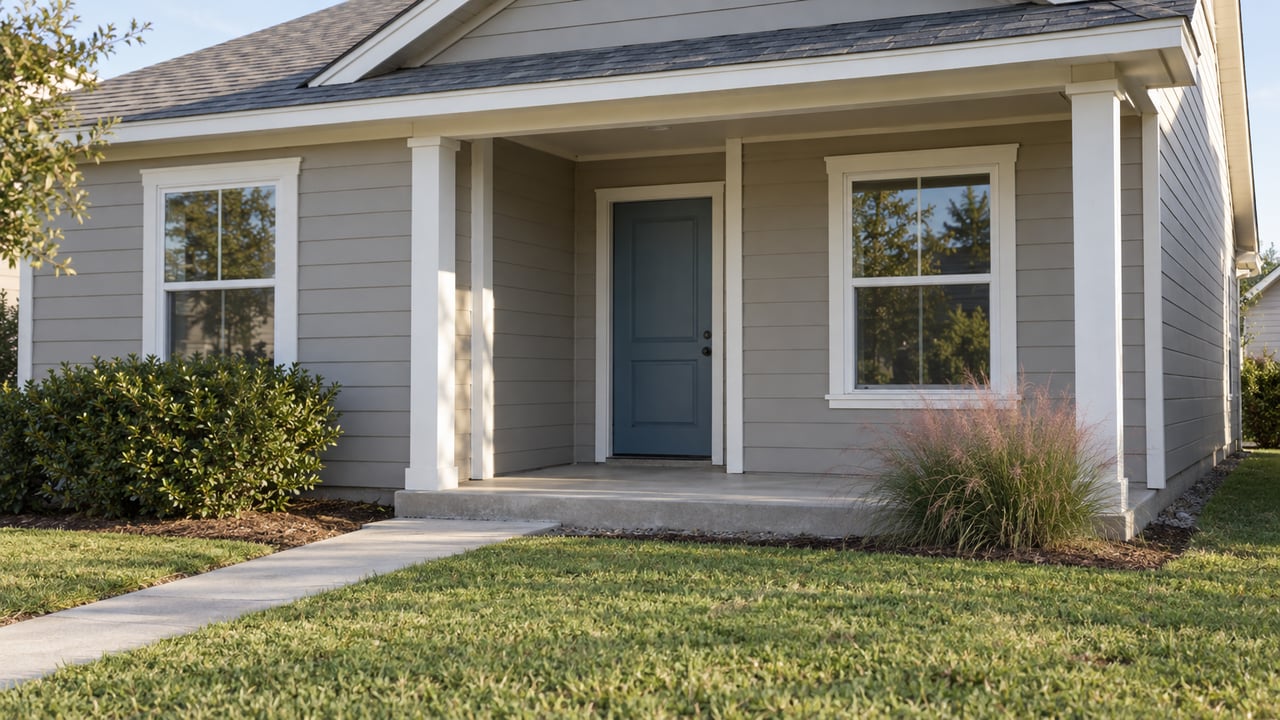
Why Market Common's Newest Homes Are Being Built Around a Six-Acre Hole
October 1, 2026
October 1, 2026
Stand at the corner of Farrow Parkway and Phillis Boulevard in Market Common and you'll notice something the walkable brick sidewalks and porch-front townhomes don't explain on their own. The new construction here doesn't sit on a normal rectangular lot. It wraps around a fenced, undeveloped six-acre center, a green gap in the middle of what will otherwise be a finished neighborhood. That gap isn't a future phase waiting for a buyer. It's the reason the whole 16-acre parcel took the better part of a decade to get built at all.
The tract is shaped like a lopsided horseshoe, and the center of that horseshoe is where the Air Force once dispensed jet fuel for the aircraft that flew out of Myrtle Beach Air Force Base. The base closed on March 31, 1993, and its 3,936 acres were eventually redeveloped into Market Common, Myrtle Beach International Airport's newer terminals, Whispering Pines Golf Course, a Horry-Georgetown Technical College campus, and thousands of new homes. Most of that land came back into use fast. This six-acre piece did not. It's owned by Horry County, deemed contaminated by the EPA, and its groundwater is still monitored by wells the Air Force maintains under an agreement it signed when the base closed.
The site sits on the last undeveloped tract inside the entire Market Common master plan, and its path to approval says more about how this neighborhood actually functions than any brochure copy about walkability ever will.
A 2022 proposal for the site called for 129 townhomes and 80 cottages. The Myrtle Beach City Council rejected a related 203-unit version in March 2023 after pushback from residents who felt the plans had been rushed through without enough community input. The developer, HomeFed Corporation, went back to the table. By September 2024 the unit count had dropped to somewhere between 189 and 192, with a swimming pool, clubhouse, and more than 400 parking spaces added to ease resident concerns. On October 22, 2024, the council voted 5-2 to give final approval to what's now called MarketWalk: 90 townhomes and 102 cottages, some starting as small as 611 square feet, plus a drive-through coffee shop that required its own separate amendment to a master plan that was never supposed to allow drive-throughs in the first place.
None of those approvals touched the six acres in the center. Retired Air Force Colonel Buddy Styers, who leads the Myrtle Beach Air Force Base Redevelopment Authority, told the council the Air Force is letting the old fuel-farm contamination break down naturally rather than actively remediating it, and in 2023 he estimated the site would remain under monitoring for roughly 30 years from the base's closure. That puts the original target somewhere in the early 2020s. Nothing in the public record since suggests that monitoring has been lifted, and the six acres are still described as contaminated and Air Force-monitored as of the council's October 2024 discussion of the surrounding development.
Practically, that means the buffer at the center of MarketWalk isn't a placeholder. It's the kind of parcel that tends to stay exactly what it is: fenced, green, and not for sale.
MarketWalk is the last piece of a puzzle that started coming together in 2004, when developers broke ground on the original 106-acre Market Common core. The first master plan was approved in 2005 and has been amended at least 20 times since, according to city planning discussion from that era. Each amendment changed what could be built where, which is why "Market Common" on a listing sheet can mean five or six genuinely different products depending on which phase a home sits in.
The original Live/Work core opened in 2008 with condos stacked above retail storefronts, designed so an owner could run a small business downstairs and live above it. Seagate Village, just south of the retail core, is built from what were originally 1980s-era military duplexes, converted into single-story condos after the base closed. Emmens Preserve and Belle Harbor came later, with Belle Harbor built by Lennar and carrying an average list price around $536,000 and roughly $269 per square foot as of 2026 listings. Cresswind is a newer resort-style enclave inside the same footprint. MarketWalk, still under construction, is the newest and last.
| Sub-community | Origin | What it actually is |
|---|---|---|
| Live/Work core | Opened 2008 | Condos above original retail storefronts, the first phase built |
| Seagate Village | Converted 1980s military housing | Single-story condos, originally base duplexes |
| Emmens Preserve | Mid-2010s | Single-family and townhome extension of the walkable core |
| Belle Harbor | Recent, Lennar-built | Single-family homes, averaging about $536,000 and $269/sq ft as of 2026 |
| Cresswind | Recent | Resort-style enclave within the same master plan |
| MarketWalk | Approved October 2024 | 90 townhomes and 102 cottages built around the monitored six-acre buffer |
The original 2005 master plan called for 1,680 residential units across the whole district. Once MarketWalk is finished, the total will land around 1,103, roughly 577 units short of what was originally planned. That gap is the fuel farm, the traffic and parking concessions negotiated over three separate proposals, and every other constraint that shaped the last parcel differently than the first.
A single median price for "Market Common" flattens all of this into one number, but a buyer comparing two listings with the same square footage and a similar price tag could be looking at a 2008 condo converted from military housing and a 2025-built townhome wrapped around an EPA-monitored buffer. Those aren't interchangeable products, even if they share a zip code and a retail district within walking distance.
Before treating any Market Common listing as generic, it's worth asking a few direct questions:
None of this makes one phase better than another. It makes them different products that happen to share a name and a walk score.
Will the six acres in the middle of MarketWalk ever get developed? Nothing in the public record points that direction. The Air Force accepted responsibility for the contamination when the base closed, the site is still monitored by state and federal environmental agencies as of the city's most recent public discussion of the parcel in October 2024, and the developer built its final approved plan specifically around leaving that center section untouched.
Does this affect other parts of Market Common, like Belle Harbor or the original retail core? The contamination and monitoring described in city and developer records apply specifically to the six-acre former fuel farm site at Farrow Parkway and Phillis Boulevard, not to the broader Market Common footprint. Other phases were built on land already cleared for reuse years earlier as part of the base's overall redevelopment.
Market Common rewards a buyer who treats it less like one neighborhood and more like six neighborhoods that happen to share a name, a walking district, and thirty years of the same base's history. Knowing which phase you're actually buying into is the difference between understanding your HOA's age and being surprised by it a year in.
If you're weighing a listing in Market Common and want to know exactly which phase it sits in, what that means for the HOA, and how it compares to a home two streets over from a different era, Nick Paolozzi at Life in Myrtle Beach tracks this neighborhood parcel by parcel. Start Your Life at the Beach.
Stay up to date on the latest real estate trends.
Whether you’re buying your first home, selling a property, or exploring Myrtle Beach living, we’re here to make the process seamless. With local expertise and a people-first approach, we’ll guide you every step of the way.